New: Take the KSM™ AI Visibility Assessment and identify what is limiting your visibility in AI-generated answers. Start now

The Knowledge Structuring Model (KSM™)

Become the organization AI understands, trusts, and recommends.

KSM™ is a platform-neutral, research-based framework for helping organizations structure, measure, and improve the knowledge signals AI systems use to understand, recognize, trust, and cite them.

Structure your knowledge. Strengthen your authority. Become the answer AI gives.

Platforms measure. KSM™ connects. Partners transform. Enterprises govern.

Continue to KSMmodel.app, the official KSM™ assessment application.

AI Visibility = f(E × S × C)

Extractable Structured Content · Entity Salience · Citation Authority

KSM ecosystem model showing technology platforms measuring AI visibility, KSM connecting the ecosystem through Extractable Structured Content, Entity Salience and Citation Authority, partners transforming, and enterprises governing.

Technology platforms provide measurement. KSM™ provides the connecting framework. Partners provide transformation. Enterprises provide governance and adoption.

  • Founded and created by Dr. Anthony Q. Bowen
  • Published in 2026
  • Original research available on SSRN
  • Platform-neutral AI visibility framework

From ranking to recognition

SEO helped people find your pages. KSM™ helps AI understand who you are.

Traditional SEO remains useful for discovery and crawlability, but AI visibility introduces a different problem: whether AI systems can understand organizational knowledge, correctly resolve the entity, and find enough independent evidence to trust and cite it.

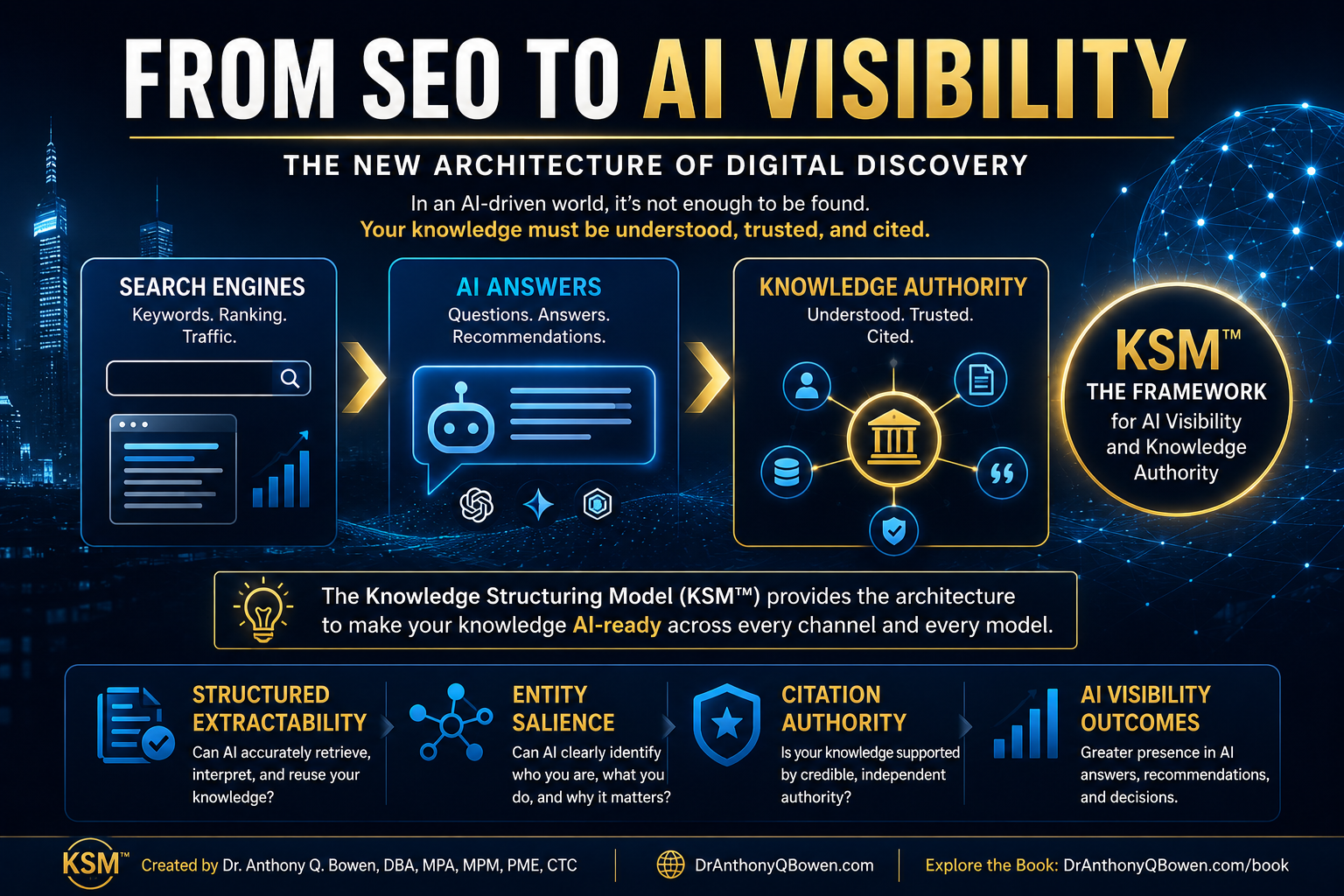
From SEO to AI visibility with the KSM model: structured content, entity salience, and citation authority replacing ranking-only thinking.
The shift from ranking-only optimization to structured knowledge, entity clarity, and citation authority.

Three pillars · one system

AI visibility is only as strong as its weakest pillar.

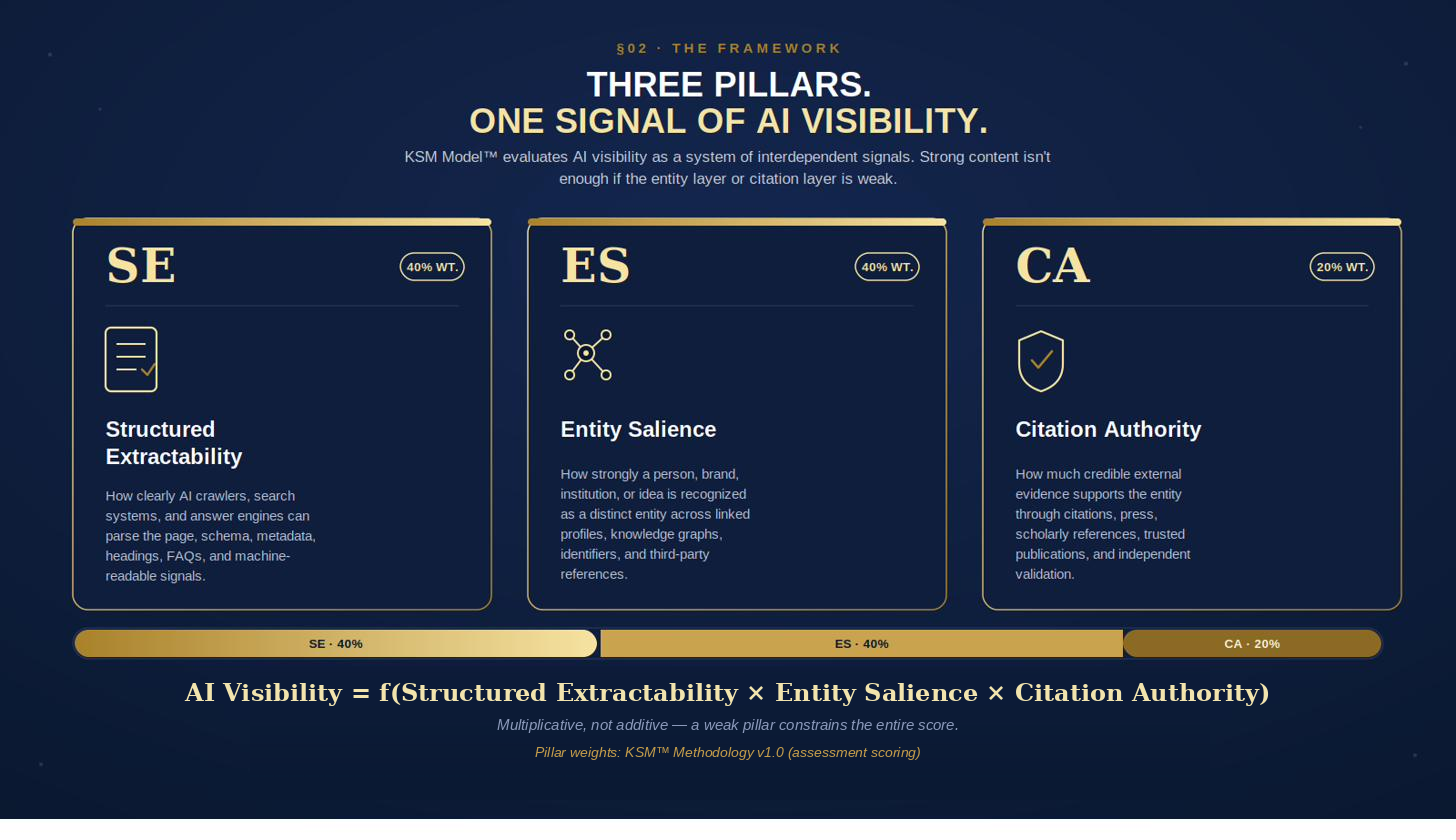
The three pillars of the Knowledge Structuring Model: Extractable Structured Content at 40 percent, Entity Salience and Knowledge Graph Alignment at 40 percent, and Citation Authority Reinforcement at 20 percent, combining into an AI visibility score.
The KSM™ three-pillar system. AI visibility is a product of the pillars, so the weakest pillar constrains the whole score.
  1. 01E · 40%

    Extractable Structured Content

    Can AI understand you?

    Measures how clearly machines can access, parse, and extract your knowledge from page structure, schema, metadata, FAQs, evidence blocks, and crawlable content.

  2. 02S · 40%

    Entity Salience and Knowledge Graph Alignment

    Can AI recognize you?

    Measures whether your brand, people, products, research, and identifiers form a consistent, connected, and unambiguous entity across your site and authoritative external sources.

  3. 03C · 20%

    Citation Authority Reinforcement

    Can AI trust and cite you?

    Measures whether independent publications, scholarly sources, media, industry references, and third-party applications reinforce your claims and authority.

The pillars multiply rather than add: a weak pillar constrains the entire score. Weights are fixed at 40 / 40 / 20 across every KSM™ assessment.

The KSM™ Assessment

Find the signal suppressing your AI visibility.

The KSM™ Assessment converts the framework into a practical diagnostic. It evaluates your digital knowledge surface, scores each pillar, and prioritizes the actions most likely to improve how AI systems understand, distinguish, and cite your organization.

Your report includes

  • Overall KSM™ AI Visibility Score
  • E score — Extractable Structured Content
  • S score — Entity Salience and Knowledge Graph Alignment
  • C score — Citation Authority Reinforcement
  • Evidence behind the findings
  • Critical gaps
  • Priority recommendations
  • A staged improvement roadmap
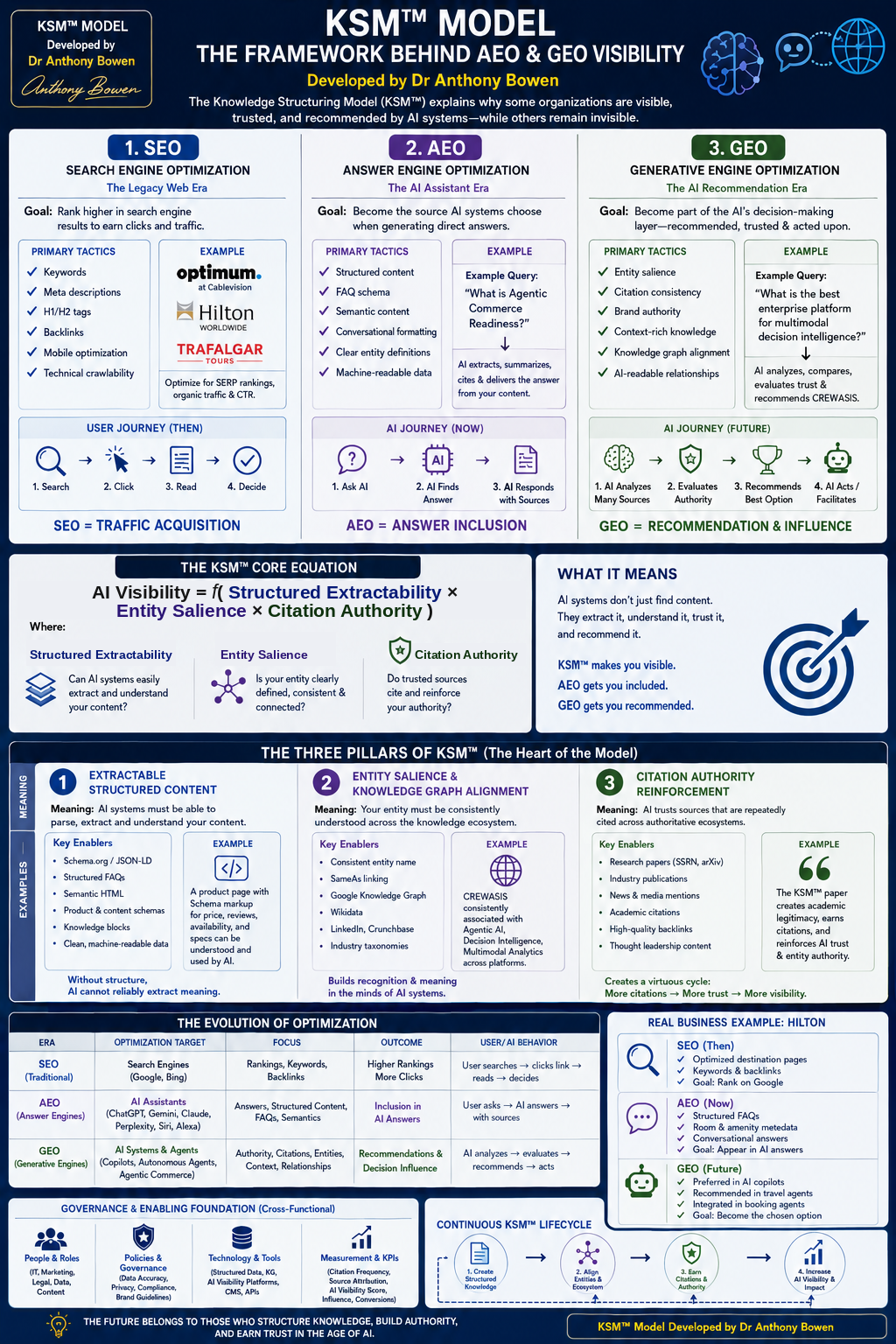
The Knowledge Structuring Model diagram showing the AI Visibility formula as a function of Extractable Structured Content, Entity Salience, and Citation Authority, with maturity stages and business impact.
Start the Assessment

Continue to KSMmodel.app, the official KSM™ assessment application.

No payment required for the introductory assessment. Marketing consent is optional.

How it works

From URL to prioritized action plan.

  1. 01

    Submit your organization and website.

    Provide only the information required to generate and deliver the assessment.

  2. 02

    Verify your email.

    We confirm the request and begin the authorized analysis.

  3. 03

    Review your KSM™ Score.

    See how your organization performs across all three pillars.

  4. 04

    Act on the weakest signal.

    Use the prioritized roadmap or request an enterprise engagement.

KSM™ AI Visibility Consulting

Turn KSM™ findings into enterprise action.

A structured program designed to improve measurable AI-visibility signals: establish the baseline, close the highest-value knowledge gaps, then protect and compound the gains.

  1. 01

    Audit

    Establish the baseline.

    Measure how AI systems currently understand, recognize, and cite the organization, and translate the findings into an executive view of risk and opportunity.

  2. 02

    Transform

    Close the highest-value knowledge gaps.

    Work the constraining pillar first, then reinforce the others so structured knowledge, entity clarity, and independent evidence advance together.

  3. 03

    Maintain

    Protect and compound AI authority.

    AI systems, sources, and competitors keep moving. Recurring measurement and governance keep gains from eroding and make progress reportable.

Built for an ecosystem

One framework. Many platforms. Many teams.

KSM™ gives technology platforms, agencies, consultants, and enterprises a common model for turning AI visibility signals into coordinated action.

Diagram of the KSM™ ecosystem. KSM™ sits at the centre as the common framework, connected to four groups: Technology Platforms, which measure & monitor; Agencies, which implement & scale; Consultants, which advise & govern; Enterprises, which adopt & operate. Each group keeps its own tools and role; KSM™ provides the shared diagnostic standard between them.

  • Technology Platforms

    Measure & Monitor

  • Agencies

    Implement & Scale

  • Consultants

    Advise & Govern

  • Enterprises

    Adopt & Operate

Platforms measure. KSM™ connects. Partners transform. Enterprises govern. KSM™ connects the ecosystem rather than replacing any part of it.

Built for defensibility

Why KSM™ becomes stronger with adoption.

KSM™ combines published research, a defined assessment methodology, proprietary implementation practices, and an expanding body of benchmark intelligence. Together, these create a repeatable system for measuring, improving, and operationalizing AI visibility across organizations.

  • Original research

    Research-backed from the start.

    KSM™ began as a formal research framework for AI-mediated visibility and citation authority — designed to be cited, tested, and extended.

    Published research · Defined terminology · Citable methodology

  • Defined measurement standard

    A consistent way to measure AI visibility.

    One defined three-pillar model: Extractable Structured Content, Entity Salience and Knowledge Graph Alignment, and Citation Authority Reinforcement.

    AI Visibility = f(E × S × C)

    E — 40% · S — 40% · C — 20%

  • Proprietary delivery system

    The framework is public. The operating system is not.

    KSM™ explains what organizations must improve. The implementation playbooks, delivery workflows, and governance methods remain proprietary.

    Framework transparency · Protected execution methodology

  • Benchmark intelligence

    Every assessment can strengthen the benchmark.

    As adoption grows, aggregated and de-identified assessment data can support stronger benchmarking across industries, maturity stages, and pillars.

    Industry benchmarks · Maturity patterns · Pillar-level insights

Research creates the framework. The framework creates the measurement system. Measurement drives implementation. Implementation generates experience. Adoption can create benchmark intelligence.

Built for adoption

A common operating model for AI visibility.

KSM™ gives teams a shared language, measurable baseline, and repeatable improvement cycle.

Enterprise leaders

Establish governance across content, data, brand, communications, technology, and knowledge management.

Marketing and communications teams

Move from isolated SEO tactics to entity-centered AI visibility and citation strategy.

Agencies and consultants

Use a consistent framework to assess clients, prioritize work, and demonstrate progress. Publishing third-party KSM™ scores requires attribution and any applicable license.

Academic and research communities

Cite, test, critique, and extend the model using the original publication and transparent methodology.

Technology platforms

Integrate KSM™ concepts into diagnostics, monitoring, and knowledge-readiness workflows through an authorized partnership.

Research program

Visibility, readiness, and agentic trust.

KSM™ sits inside a wider research program connecting external AI visibility, internal enterprise knowledge readiness, and evidence sufficiency for agentic systems.

  1. 01

    KSM™

    Can AI understand, recognize, trust, and cite the organization?

  2. 02

    EKR

    Is enterprise knowledge structured and ready for AI consumption and operation?

  3. 03

    Warrant Clearing

    Can agentic systems evaluate whether evidence and authority are sufficient for trusted action?

Bowen, A. Q. (2026). The Knowledge Structuring Model (KSM™): A Socio-Technical Framework for AI-Mediated Visibility and Citation Authority. SSRN Working Paper 6721140.

Latest articles

Writing from the creator of KSM™.

Featured header image for the article From SEO to AI Visibility, framed around the Knowledge Structuring Model.

Featured · AI Visibility

From SEO to AI Visibility

Dr. Anthony Q. Bowen · · 9 min read

Traditional SEO still matters for discovery and crawlability, but it answers a different question than AI-mediated visibility. This piece explains the shift from ranking pages to being understood, recognized, and cited as an entity.

Read in the Articles hub

  • KSM™

    The Knowledge Structuring Model (KSM™): An Introduction

    · 12 min read

    The original framework in summary: why AI visibility behaves as a product of extractable structured content, entity salience, and citation authority rather than a sum of tactics.

  • AEO & GEO

    AEO and GEO: What Changes When the Answer Replaces the Result

    · 8 min read

    Answer-engine and generative-engine visibility depend on retrievable evidence and resolvable entities. A practical view of what teams should measure instead of position.

  • Enterprise Knowledge Readiness

    Enterprise Knowledge Readiness: Beyond AI Visibility

    · 10 min read

    External visibility is only half the problem. EKR examines whether enterprise knowledge is structured, governed, accessible, and reliable enough for AI and agentic systems to operate on.

Founder and creator

Dr. Anthony Q. Bowen

Dr. Anthony Q. Bowen is the founder and creator of the Knowledge Structuring Model (KSM™), a research-based framework for AI-mediated visibility and citation authority. His work connects structured knowledge, entity recognition, knowledge-graph alignment, and independent citation signals into a practical operating model for organizations navigating AI-driven discovery.

KSM™ Knowledge Center

Frequently asked questions

The most common questions about the Knowledge Structuring Model (KSM™), AI visibility, and the assessment. Every answer is also available in the full knowledge center.

What is the Knowledge Structuring Model (KSM™)?

The Knowledge Structuring Model (KSM™) is a research-based socio-technical framework for measuring and improving AI-mediated visibility and citation authority.

It evaluates whether AI systems can understand an organization's knowledge, correctly recognize the organization as an entity, and find sufficient independent evidence to trust and cite it. KSM™ was developed by Dr. Anthony Q. Bowen.

KSM™ evaluates whether AI systems can:

  • understand an organization's knowledge,
  • correctly recognize the organization as an entity, and
  • find sufficient independent evidence to trust and cite it.

Does KSM™ replace SEO?

No. SEO remains important for technical accessibility, crawling, indexing, content discovery, and search performance.

KSM™ extends beyond traditional page-level visibility by evaluating structured knowledge, entity recognition, knowledge-graph alignment, and citation authority. A strong SEO foundation can support AI visibility, but SEO alone does not guarantee that AI systems will understand, recognize, trust, or cite an organization.

What is the KSM™ formula?

AI Visibility = f(E × S × C).

The model treats the three pillars as interdependent rather than isolated optimization tactics.

Where:

  • E — Extractable Structured Content — 40%
  • S — Entity Salience and Knowledge Graph Alignment — 40%
  • C — Citation Authority Reinforcement — 20%

What is the KSM™ AI Visibility Assessment?

The KSM™ Assessment converts the framework into an actionable diagnostic.

It evaluates an organization's digital knowledge surface across the three KSM™ pillars and identifies areas that may be limiting AI visibility.

Does KSM™ require replacing our existing technology platform?

No. KSM™ is platform-neutral.

Organizations can continue using their existing enterprise SEO, AI visibility, analytics, content, and digital-experience platforms while using KSM™ as the common framework for diagnosis, prioritization, transformation, and governance.

Does KSM™ guarantee that ChatGPT or another AI system will cite my organization?

No. No responsible AI visibility methodology can guarantee how an independent AI platform will generate a future answer.

AI outputs vary based on:

  • model,
  • retrieval method,
  • data sources,
  • prompt wording,
  • geography,
  • personalization,
  • system updates,
  • and other factors outside KSM™ control.

The KSM™ Assessment is an evidence-based diagnostic, not a guarantee of placement or citation.

What happens after the KSM™ Assessment?

Organizations can use the findings internally or engage KSM™ capabilities to support implementation.

The public operating model is Audit → Transform → Maintain.

Can my company adopt KSM™ internally?

Yes. Organizations may use the published framework as an internal reference and operating model with appropriate attribution.

Commercial scoring, certification, third-party assessment publication, white-labeling, or technology integration may require authorization or licensing.

Your organization already has an AI visibility profile. Measure it.

Identify what AI can understand, where entity ambiguity exists, and which authority signals need reinforcement.

Pillar weights: E 40% · S 40% · C 20%. KSM™ scores are diagnostics, not guarantees of AI placement or citation.