KSM Model Logo
Muse Platforms™ presents: The KSM Model™ Standard

THE AI SHIFT IS UPON US

Do you still optimize your website for SEO? Meanwhile, your traffic is diminishing and your customers have already shifted to using AI.

Get your free KSM Model™ AI Visibility Score — the benchmark for how findable your brand is across ChatGPT, Claude, Gemini, and Perplexity.

AI Visibility = f(SE × ES × CA)

Based on the Knowledge Structuring Model™ Framework

§01 · The Problem

AI Does Not Reward Noise. It Rewards Structure.

AI systems don't rank pages the way search engines do. They retrieve, parse, compare, cite, and synthesize structured knowledge. When the structure is weak, the entity gets diluted — or replaced.

Brands are invisible
when AI can't parse them cleanly.
Experts are overlooked
when their entity signals are thin.
Ideas get diluted
when citations don't reinforce them.
SEO is not enough
for AI answer visibility.
§02 · The Framework

Three Pillars. One Signal of AI Visibility.

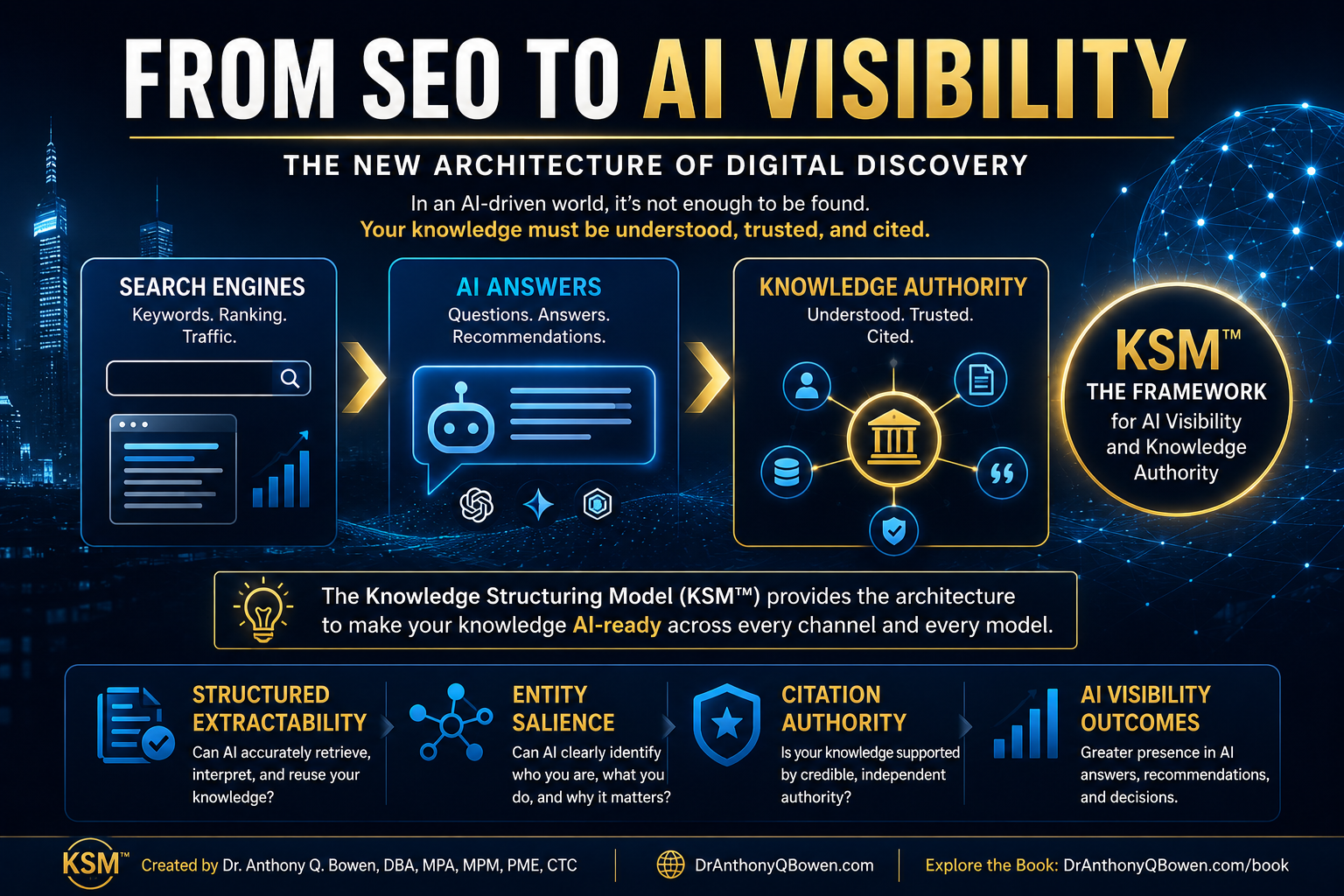
KSM Model™ evaluates AI visibility as a system of interdependent signals. Strong content isn't enough if the entity layer or citation layer is weak.

SEWeight 40%

Structured Extractability

How clearly AI crawlers, search systems, and answer engines can parse the page, schema, metadata, headings, FAQs, and machine-readable signals.

ESWeight 40%

Entity Salience

How strongly a person, brand, institution, or idea is recognized as a distinct entity across linked profiles, knowledge graphs, identifiers, and third-party references.

CAWeight 20%

Citation Authority

How much credible external evidence supports the entity through citations, press, scholarly references, trusted publications, and independent validation.

§03 · The Formula

KSM Model™ Composite Signal

AI Visibility = f(Structured Extractability × Entity Salience × Citation Authority)
Composite score · 0–100 · SE 40 · ES 40 · CA 20

A site can perform on content and still underperform in AI answers if the entity layer or citation layer is weak. KSM Model™ makes those gaps visible.

§04 · What KSM Model™ Measures

The Signal Layer Behind Every Score.

Structured Signals
  • Schema and metadata
  • Heading hierarchy
  • FAQ and answer extractability
  • Machine-readable evidence blocks
Entity Signals
  • Knowledge graph presence
  • ORCID · Wikidata · Scholar
  • Institutional identifiers
  • Cross-web sameAs consistency
Citation Signals
  • Press and third-party citations
  • AI query recognition
  • Citation risk
  • Entity ambiguity · name collision
§05 · Use Cases

Built For People, Brands, and Institutions That Must Be Recognized.

Academic Experts
Establish scholarly entity presence across Scholar, ORCID, and Wikidata.
Founders
Anchor personal-brand entity signals to a defensible knowledge surface.
Consultants
Turn thought leadership into citable, extractable, AI-visible authority.
Institutions
Map organizational entities to a durable knowledge-graph footprint.
AEO / GEO Strategy
Move beyond SEO into answer-engine and generative-engine visibility.
Citation Planning
Strengthen the third-party evidence base that AI systems rely on.
§06 · About the Model

An Open Standard for AI Visibility.

The Knowledge Structuring Model was formalized by Dr. Anthony Q. Bowen and is maintained as an open framework for measuring entity discoverability, structured extractability, and citation authority in the age of generative retrieval.

About the StandardRead the Methodology
Get Your KSM Model™ Score

See how AI systems recognize, extract, and cite your entity today.

Request a KSM Model™ AssessmentExplore the Framework