KSM™ AI Visibility Consulting
Turn KSM™ findings into enterprise action.
KSM™ consulting helps organizations diagnose, structure, align, reinforce, and continuously improve the knowledge signals AI systems use to understand, recognize, and cite them.
Three stages · one program
Audit. Transform. Maintain.
A structured program designed to improve measurable AI-visibility signals. Each stage produces evidence the next stage acts on, so improvement follows the constraint rather than the calendar.
- 01
Audit
Establish the baseline.
Measure how AI systems currently understand, recognize, and cite the organization, and translate the findings into an executive view of risk and opportunity.
Capabilities
- AI visibility diagnostic
- KSM™ pillar scoring
- Maturity baseline
- Entity assessment
- Authority assessment
- Gap prioritization
- Competitive context
- Executive roadmap
- 02
Transform
Close the highest-value knowledge gaps.
Work the constraining pillar first, then reinforce the others so structured knowledge, entity clarity, and independent evidence advance together.
Capabilities
- Structured knowledge architecture
- Semantic content improvement
- Schema and structured-data strategy
- Entity consistency
- Knowledge-graph alignment
- Author and expert attribution
- Citation-authority development
- AI-ready content systems
- Cross-functional governance
- 03
Maintain
Protect and compound AI authority.
AI systems, sources, and competitors keep moving. Recurring measurement and governance keep gains from eroding and make progress reportable.
Capabilities
- Recurring KSM™ reassessment
- AI visibility monitoring
- Citation monitoring
- Competitive drift analysis
- Remediation recommendations
- Executive reporting
- Governance reviews
- Continuing knowledge alignment
Built for defensibility
Why KSM™ becomes stronger with adoption.
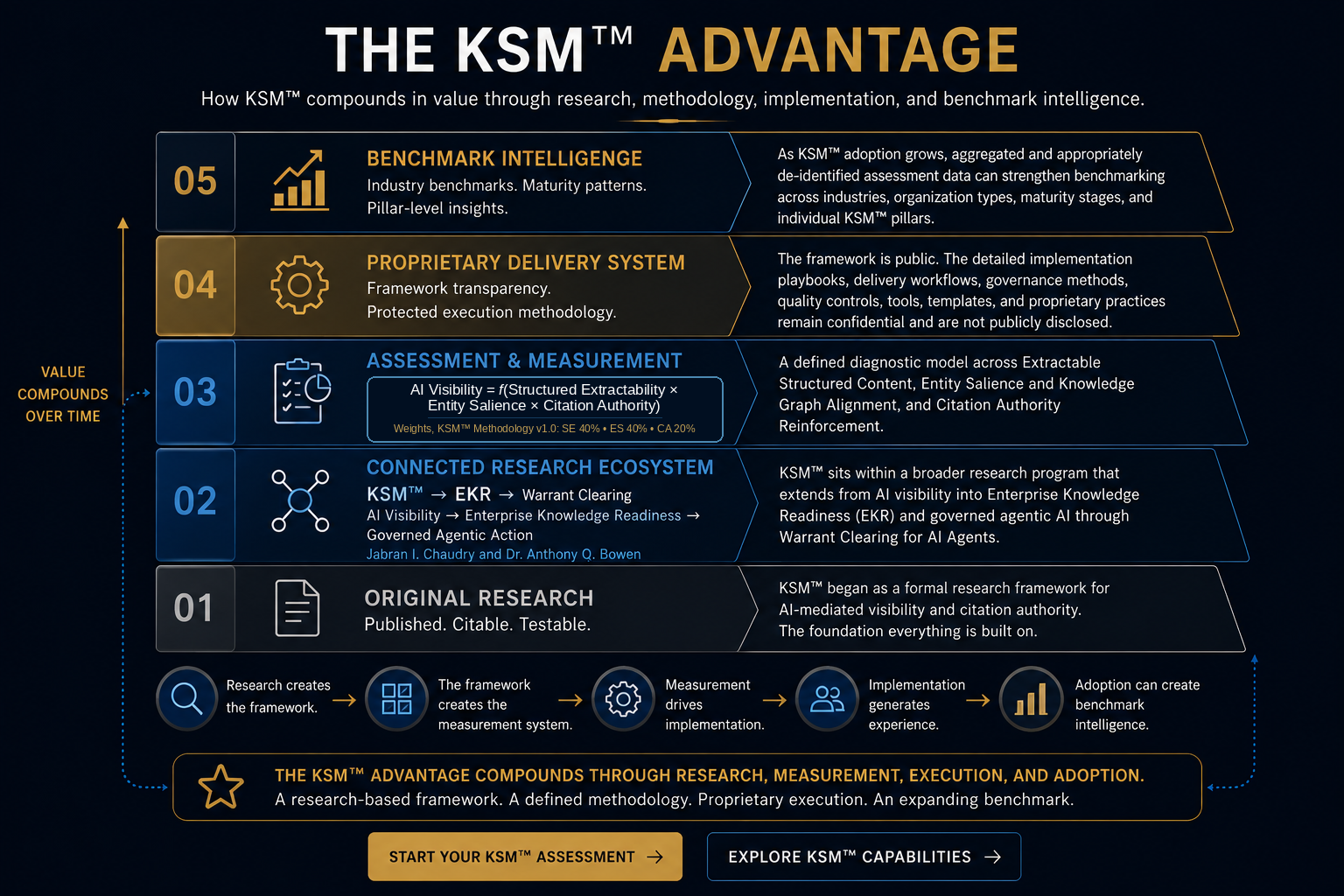
KSM™ combines published research, a defined assessment methodology, proprietary implementation practices, and an expanding body of benchmark intelligence. Together, these create a repeatable system for measuring, improving, and operationalizing AI visibility across organizations.
Original research
Research-backed from the start.
KSM™ originated as a formal research framework for AI-mediated visibility and citation authority. Its foundation is designed to be cited, tested, challenged, and extended rather than presented as an unsupported marketing concept.
Published research · Defined terminology · Citable methodology
Defined measurement standard
A consistent way to measure AI visibility.
KSM™ uses a defined three-pillar model across Structured Extractability, Entity Salience, and Citation Authority.
AI Visibility = f(Structured Extractability × Entity Salience × Citation Authority)
Pillar weights in the KSM™ assessment methodology (v1.0): SE 40% · ES 40% · CA 20%
Proprietary delivery system
The framework is public. The operating system is not.
KSM™ explains what organizations must improve. The detailed implementation playbooks, delivery workflows, governance methods, sequencing, internal templates, quality controls, and consulting procedures remain proprietary.
Framework transparency · Protected execution methodology
Benchmark intelligence
Every assessment can strengthen the benchmark.
As KSM™ adoption grows, aggregated and appropriately de-identified assessment data can support stronger benchmarking across industries, organization types, maturity stages, and individual KSM™ pillars.
Industry benchmarks · Maturity patterns · Pillar-level insights
Connected research ecosystem
Visibility is only the beginning.
KSM™ sits within a broader research program that extends from AI visibility into Enterprise Knowledge Readiness (EKR) and governed agentic AI through Warrant Clearing, research authored by Jabran I. Chaudry and Dr. Anthony Q. Bowen.
KSM™ → EKR → Warrant Clearing
AI Visibility · Enterprise Knowledge Readiness · Governed Agentic Action
Research creates the framework. The framework creates the measurement system. Measurement drives implementation. Implementation generates experience. Adoption can create benchmark intelligence.
Capability areas
Five areas of work, sequenced by constraint.
Discover & Benchmark
Establish where the organization stands today across all three KSM™ pillars, with evidence and competitive context.
Structure
Make organizational knowledge extractable: architecture, semantics, definitions, and structured data that match visible content.
Align
Resolve the entity. Consistent naming, stable identifiers, and connected people, products, and research across authoritative sources.
Reinforce
Develop independent evidence — publications, scholarly sources, media, and third-party references — that corroborates the organization's claims.
Measure & Govern
Instrument reassessment, ownership, and reporting so AI-visibility signals are managed as an ongoing program.
A paradigm shift
What changes when answers replace result lists.
Conventional optimization targets an index of documents. KSM™ targets the knowledge structures generative systems reason over before they answer.
| Capability dimension | Traditional SEO | KSM™ AI visibility |
|---|---|---|
| Primary metric | Page rankings, clicks, and impression traffic | AI citation frequency and presence in direct answers |
| Core unit | Keywords and matching phrases | Entities, knowledge schemas, and graphs |
| Authority signal | Backlink volume and domain metrics | Trusted source attribution and factual corroboration |
| Content delivery | Document indexation and a retrieval list | Synthesis, contextual reasoning, and generated answers |
Maturity lifecycle
Five stages from search presence to AI authority.
The lifecycle describes where an organization sits today and what the next constraint is. Stages are cumulative: later stages depend on the structures established earlier.
This maturity model extends Figure 2 of the SSRN paper, which names the first two stages Unstructured Presence and Structured Content Adoption.
- Stage 1
Search presence
Legacy baseline: basic technical crawlability and conventional SEO hygiene.
- Stage 2
Structured presence
Machine-readable optimization through semantic HTML, JSON-LD, and consistent schemas.
- Stage 3
Entity alignment
Reconciliation with knowledge graphs, Wikidata, and authoritative directories.
- Stage 4
Citation authority
Becoming a corroborated, repeatedly selected citation source for generated answers.
- Stage 5
AI authority
Consistently synthesized as a reference across major agent and assistant environments.
Delivery arc
A first ninety days shaped by the audit.
Sequencing is indicative, not a fixed package. Scope and pace follow the findings of the assessment.
Foundation and technical
Resolve audit findings: crawlability, semantic structure, and comprehensive schema deployment.
Entity optimization
Align profiles across entity networks, reinforce biographical and organizational schema, and expand corroborating references.
Validation and scale
Re-measure against baseline signals, refine citation pathways, and set a longer-term scaling blueprint.
How it works
From URL to prioritized action plan.
- 01
Submit your organization and website.
Provide only the information required to generate and deliver the assessment. Start with the KSM™ Assessment.
- 02
Verify your email.
We confirm the request and begin the authorized analysis.
- 03
Review your KSM™ Score.
See how your organization performs across all three pillars.
- 04
Act on the weakest signal.
Use the 90-day KSM™ plan or request an enterprise engagement.
One connected framework
Visibility, readiness, and agentic trust in one program.
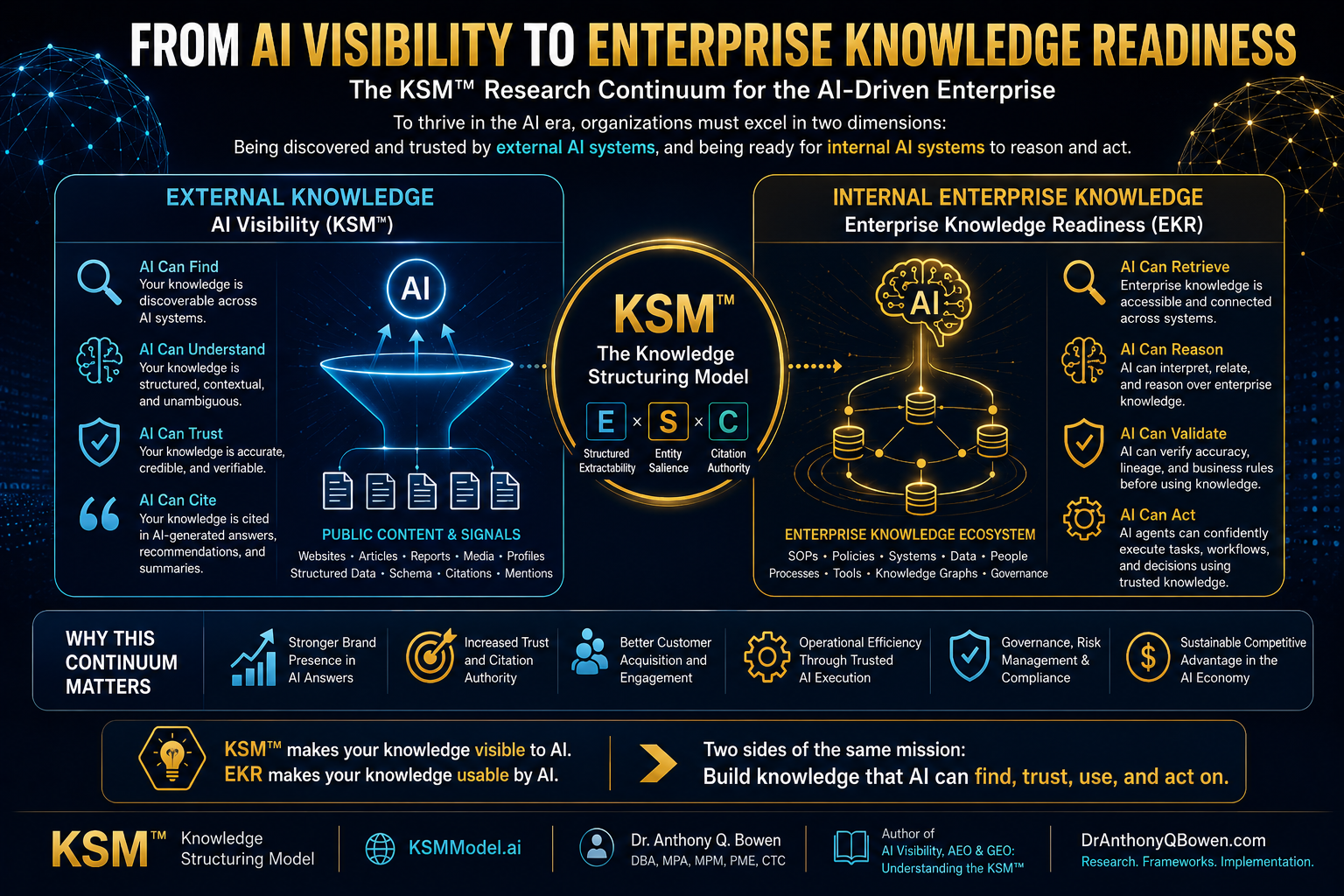
Consulting engagements draw on the wider research program: KSM™ for external AI visibility, Enterprise Knowledge Readiness for internal knowledge operations, and Warrant Clearing for agentic evidence sufficiency.
Enterprise Knowledge Readiness (EKR)
EKR concerns an organization’s capability to structure, govern, maintain, and operationalize its internal knowledge for AI use. It examines whether AI systems can retrieve relevant knowledge, identify the entities and relationships involved, and trace answers or proposed actions to authoritative evidence.
Who we serve
Categories where knowledge and trust decide the answer.
Enterprise Brands
Coordinate content, brand, data, and technology functions around one measurable AI visibility baseline.
B2B SaaS and Technology
Ensure AI systems resolve product categories, capabilities, and integrations to the correct company entity.
Healthcare & Pharma
Reinforce evidence, authorship, and review signals in categories where trust and provenance carry the most weight.
Financial Services
Align regulated, expertise-heavy content with entity clarity and independent citation support.
Higher Education
Connect institutions, faculty, programs, and published research into a coherent, citable knowledge graph.
Agencies and Consultants
Apply a consistent framework across clients to assess, prioritize, and demonstrate progress with attribution.
Start with measurement, then decide the scope.
The introductory assessment establishes the baseline. Enterprise engagements are scoped against that evidence, not a generic package.
KSM™ engagements improve measurable signals; they do not guarantee AI placement, citation, recommendation, traffic, or revenue. Delivery methods, templates, and internal procedures are proprietary and are not published.