The KSM™ Framework
One model for whether AI can understand, recognize, and cite you.
The Knowledge Structuring Model (KSM™) is a socio-technical framework created by Dr. Anthony Q. Bowen that treats AI visibility as the product of three interdependent pillars rather than a list of tactics.
The SSRN paper writes the equation with the full pillar names, and its Figure 1 abbreviates them as E, S, and C. SE, ES, and CA are used on this site as short labels for the same three pillars. The paper's abstract describes the pillars as extractable structured content, entity salience and knowledge graph alignment, and citation authority reinforcement.
AI Visibility = f(Structured Extractability × Entity Salience × Citation Authority)
Structured Extractability · Entity Salience · Citation Authority
Three pillars · one system
The pillars multiply. The weakest one governs the outcome.
Because the pillars are multiplicative, strong content cannot compensate for an ambiguous entity, and a well-modeled entity cannot compensate for absent independent corroboration.
The Three Pillars of AI Visibility
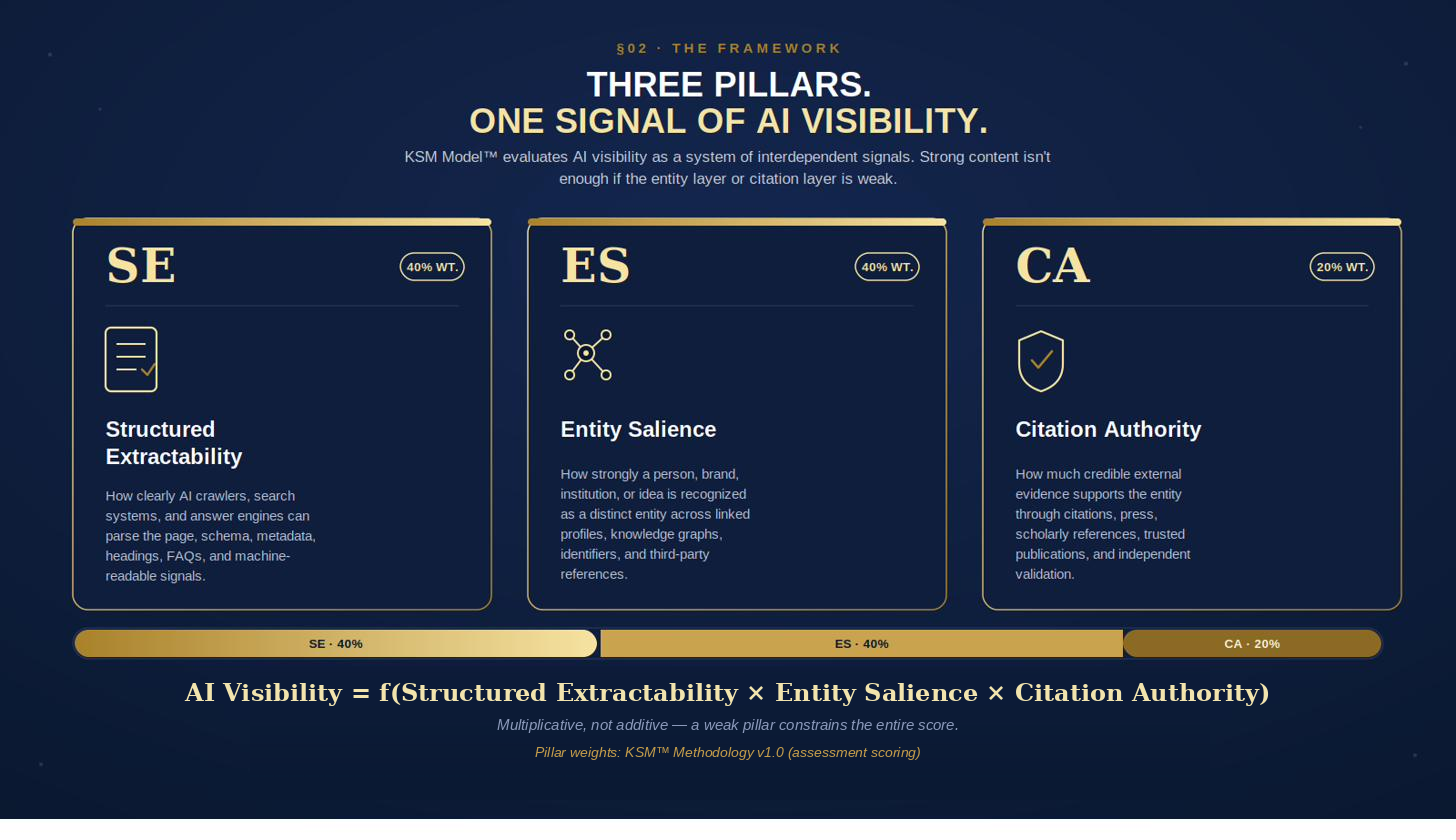
The Knowledge Structuring Model (KSM™) measures AI Visibility through three interdependent pillars: Structured Extractability (SE), Entity Salience (ES), and Citation Authority (CA).
These correspond to the original KSM™ constructs:
- E — Extractable Structured Content (40%)
- S — Entity Salience & Knowledge Graph Alignment (40%)
- C — Citation Authority Reinforcement (20%)
AI Visibility = f(E × S × C)
The operational shorthand SE × ES × CA represents these same three constructs. They are equivalent representations of the same KSM™ framework, not different versions of the model.
- 01SE · 40%
Structured Extractability (SE)
E — Extractable Structured Content
Can AI understand you?
Measures how clearly machines can access, parse, and extract your knowledge from page structure, schema, metadata, FAQs, evidence blocks, and crawlable content.
- 02ES · 40%
Entity Salience (ES)
S — Entity Salience & Knowledge Graph Alignment
Can AI recognize you?
Measures whether your brand, people, products, research, and identifiers form a consistent, connected, and unambiguous entity across your site and authoritative external sources.
- 03CA · 20%
Citation Authority (CA)
C — Citation Authority Reinforcement
Can AI trust and cite you?
Measures whether independent publications, scholarly sources, media, industry references, and third-party applications reinforce your claims and authority.
The pillars multiply rather than add: a weak pillar constrains the entire score. Pillar weights in the KSM™ assessment methodology (v1.0): SE 40% · ES 40% · CA 20%.
Plain language
KSM™ Explained Simply
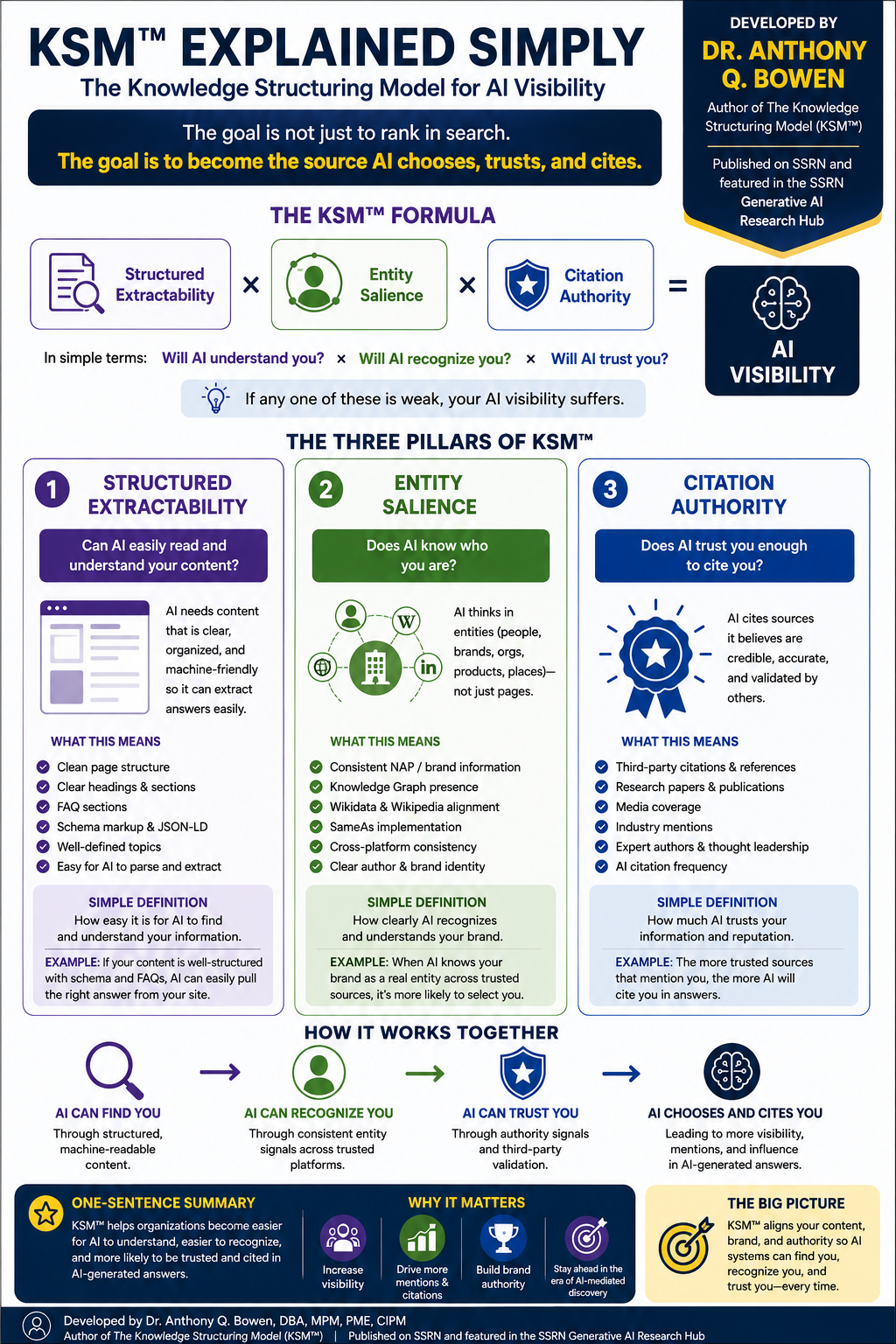
Three questions, asked in order. If AI cannot understand your knowledge, recognition never happens. If it cannot recognize your entity, citation never happens.
Signals
What each pillar examines.
SE · 40%
Structured Extractability (SE)
E — Extractable Structured Content
Can AI understand you?
Measures how clearly machines can access, parse, and extract your knowledge from page structure, schema, metadata, FAQs, evidence blocks, and crawlable content.
- Machine-readable page structure and heading hierarchy
- Valid, linked JSON-LD that matches visible content
- Evidence blocks, definitions, and answerable FAQ content
- Crawlable, server-rendered critical copy
ES · 40%
Entity Salience (ES)
S — Entity Salience & Knowledge Graph Alignment
Can AI recognize you?
Measures whether your brand, people, products, research, and identifiers form a consistent, connected, and unambiguous entity across your site and authoritative external sources.
- Consistent organization, people, and product naming
- Stable entity identifiers reused across properties
- Knowledge-graph alignment with authoritative external sources
- Disambiguation from similarly named entities
CA · 20%
Citation Authority (CA)
C — Citation Authority Reinforcement
Can AI trust and cite you?
Measures whether independent publications, scholarly sources, media, industry references, and third-party applications reinforce your claims and authority.
- Independent publications and media references
- Scholarly and research citations
- Industry references and third-party applications
- Corroboration of claims outside your own domain
Framework identity
A citable framework with a stable identifier.
The framework is published, versioned, and citable. It is identified as https://ksmmodel.ai/#ksm-framework and is creator-linked to Dr. Bowen's Person entity at https://dranthonyqbowen.com/#person.
Bowen, Anthony, The Knowledge Structuring Model (KSM™): A Socio-Technical Framework for AI-Mediated Visibility and Citation Authority (May 05, 2026). Available at SSRN: https://ssrn.com/abstract=6721140 or http://dx.doi.org/10.2139/ssrn.6721140