New: Take the KSM™ AI Visibility Assessment and identify what is limiting your visibility in AI-generated answers. Start now

Original research · practical application

Research Program for AI Visibility and Enterprise Knowledge Readiness

KSM™ was formalized in 2026 by Dr. Anthony Q. Bowen, founder and creator of the Knowledge Structuring Model (KSM™). The program now spans three connected modules: external AI visibility, internal knowledge readiness, and evidence sufficiency for agentic systems.

Research continuum

Three questions, in order.

Each module answers a different question, and each depends on the one before it. Read top to bottom.

  1. 01

    KSM™

    Can AI understand, recognize, trust, and cite the organization?

  2. 02

    EKR

    Is enterprise knowledge structured and ready for AI consumption and operation?

  3. 03

    Warrant Clearing

    Can agentic systems evaluate whether evidence and authority are sufficient for trusted action?

Module 01 · KSM™

The Knowledge Structuring Model.

The founding paper argues that AI-mediated visibility depends on three interdependent conditions: knowledge machines can extract, an entity they can unambiguously recognize, and authority independent sources reinforce.

The Knowledge Structuring Model (KSM™): A Socio-Technical Framework for AI-Mediated Visibility and Citation Authority

Dr. Anthony Q. Bowen · 2026 · SSRN Working Paper 6721140

AI Visibility = f(E × S × C)

Extractable Structured Content (40%) · Entity Salience and Knowledge Graph Alignment (40%) · Citation Authority Reinforcement (20%)

Module 02 · Enterprise Knowledge Readiness

Enterprise Knowledge Readiness (EKR).

KSM™ addresses external AI visibility. EKR extends the research into whether enterprise knowledge is structured, governed, accessible, reliable, and ready for use by AI and agentic systems.

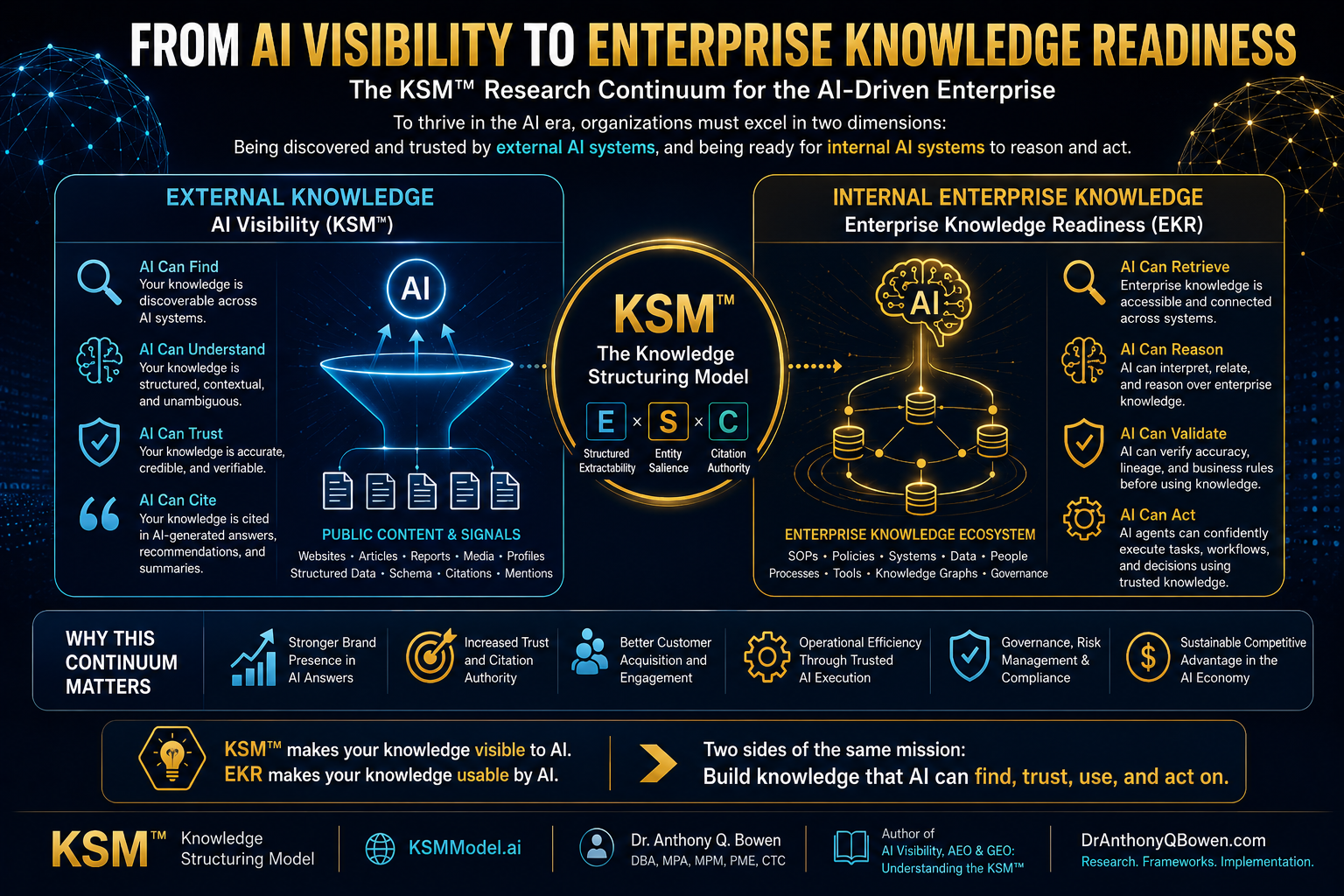
Diagram of the relationship between the Knowledge Structuring Model and Enterprise Knowledge Readiness, showing external AI visibility alongside internal knowledge readiness.
KSM™ measures external AI visibility; Enterprise Knowledge Readiness examines whether internal knowledge is structured and ready for AI use.

Beyond AI Visibility

An organization can be visible to AI systems externally while its internal knowledge remains fragmented, undocumented, or ungoverned. EKR examines that second surface: how knowledge is created, structured, maintained, permissioned, and retrieved inside the enterprise, and whether it can support AI-assisted and agentic operation reliably.

  • Is knowledge structured and machine-readable at the source?
  • Is ownership and governance defined and current?
  • Is the right knowledge accessible to the right systems and people?
  • Is it reliable enough to be acted on without human re-verification?

Read the EKR entry

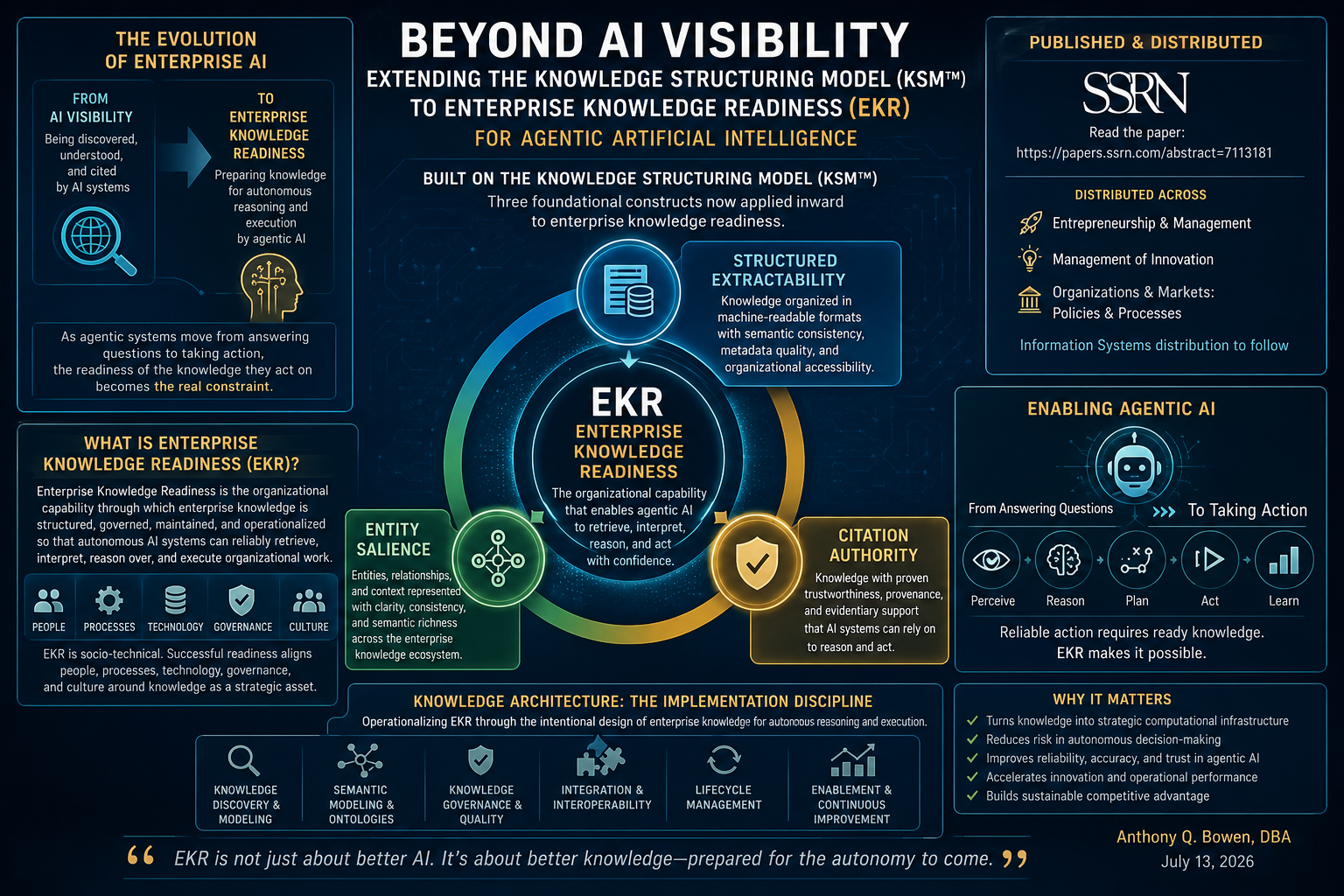
Enterprise Knowledge Readiness beyond AI visibility: structured, governed, accessible, and reliable knowledge for AI and agentic systems.
Beyond AI visibility: whether enterprise knowledge is structured, governed, accessible, reliable, and usable by AI and agentic systems.

Module 03 · Agentic AI

Warrant Clearing for AI Agents.

Research by Jabran I. Chaudry and Dr. Anthony Q. Bowen examining how agentic systems can determine whether the evidence and authority behind a claim are sufficient to act on — a prerequisite for delegating consequential decisions to autonomous systems.

One connected enterprise framework

Three modules, one dependency chain: each stage supplies what the next one needs.

  1. 01 · KSM™

    External AI visibility

    Extractable structured content, entity salience, and citation authority determine whether AI systems can understand, resolve, and cite the organization.

  2. 02 · EKR

    Enterprise Knowledge Readiness

    Internal knowledge must be structured, governed, accessible, and reliable before AI and agentic systems can operate on it.

  3. 03 · Warrant Clearing

    Agentic evidence sufficiency

    Before an agent acts, it must judge whether the available evidence and authority are sufficient — the judgment the first two modules make possible.

Warrant clearing connects directly to KSM™: the same signals that let an AI system recognize and cite an organization are the signals an agent needs in order to judge whether acting on that organization's knowledge is warranted.

Read the Warrant Clearing entry

Built for defensibility

Why KSM™ becomes stronger with adoption.

KSM™ combines published research, a defined assessment methodology, proprietary implementation practices, and an expanding body of benchmark intelligence. Together, these create a repeatable system for measuring, improving, and operationalizing AI visibility across organizations.

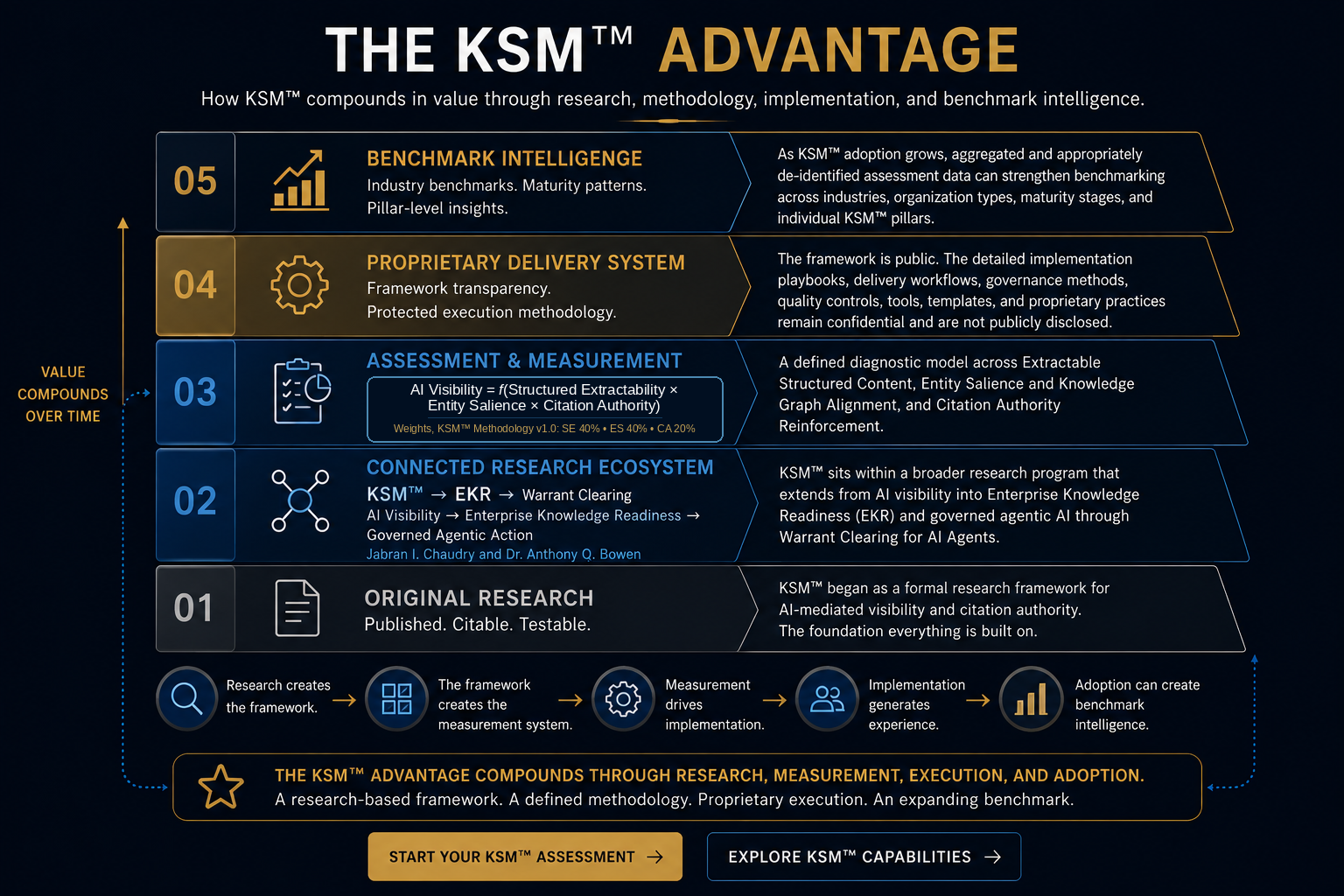
The KSM Advantage in five tiers: 01 Original Research, published, citable, and testable; 02 Connected Research Ecosystem, KSM to Enterprise Knowledge Readiness to Warrant Clearing for AI Agents, research by Jabran I. Chaudry and Dr. Anthony Q. Bowen; 03 Assessment and Measurement, AI Visibility = f(E × S × C) with E 40 percent, S 40 percent, and C 20 percent; 04 Proprietary Delivery System, where the framework is public but implementation playbooks, workflows, governance methods, quality controls, and templates remain confidential; 05 Benchmark Intelligence, where aggregated and de-identified assessment data can strengthen benchmarking across industries, organization types, maturity stages, and pillars. A flow beneath shows research creating the framework, the framework creating the measurement system, measurement driving implementation, implementation generating experience, and adoption creating benchmark intelligence, so value compounds over time.
How KSM™ compounds in value through research, methodology, implementation, and benchmark intelligence.
  • Original research

    Research-backed from the start.

    KSM™ began as a formal research framework for AI-mediated visibility and citation authority — designed to be cited, tested, and extended.

    Published research · Defined terminology · Citable methodology

  • Connected research ecosystem

    Visibility is only the beginning.

    KSM™ sits within a broader program extending into Enterprise Knowledge Readiness (EKR) and governed agentic AI through Warrant Clearing — research by Jabran I. Chaudry and Dr. Anthony Q. Bowen.

    KSM™ → EKR → Warrant Clearing

    AI Visibility · Enterprise Knowledge Readiness · Governed Agentic Action

  • Benchmark intelligence

    Every assessment can strengthen the benchmark.

    As adoption grows, aggregated and de-identified assessment data can support stronger benchmarking across industries, maturity stages, and pillars.

    Industry benchmarks · Maturity patterns · Pillar-level insights

Research creates the framework. The framework creates the measurement system. Measurement drives implementation. Implementation generates experience. Adoption can create benchmark intelligence.

How to cite

Citation.

Bowen, A. Q. (2026). The Knowledge Structuring Model (KSM™): A Socio-Technical Framework for AI-Mediated Visibility and Citation Authority. SSRN Working Paper 6721140.

When referencing pillar scores or methodology, also cite KSM™ Methodology v1.0 (2026) and the assessment date. Attribution to Dr. Anthony Q. Bowen as founder and creator is required. Framework identifier: https://ksmmodel.ai/#ksm-framework.

Related work

Book and applied writing.

Research updates are published via the KSM™ research feed.

Extend the model

Test it, critique it, build on it.

Researchers and practitioners are invited to replicate, evaluate, and extend KSM™ using the published methodology.