Resources
Practical guidance for implementing KSM™.
A staged roadmap, citation instructions, and answers to the questions teams ask most often when adopting the framework.
Implementation roadmap
Sequence the work by constraint.
Phase 1 · Baseline
Run a KSM™ assessment, record the methodology version and evidence date, and identify the constraining pillar.
Phase 2 · Extractability
Fix heading structure, server-render critical copy, publish schema that matches visible content, and add answerable definitions and FAQs.
Phase 3 · Entity alignment
Standardize naming, adopt stable identifiers, connect people and products, and remove ambiguity against similarly named entities.
Phase 4 · Citation authority
Earn independent references from publications, scholarly sources, media, and third-party applications that corroborate your claims.
Phase 5 · Operating cadence
Assign pillar owners, re-assess on a schedule, and track score movement against a documented baseline.
Citation instructions
How to reference KSM™ correctly.
Attribute the framework to Dr. Anthony Q. Bowen as founder and creator, cite the original publication, and name the methodology version whenever you report scores.
Paper
Bowen, Anthony, The Knowledge Structuring Model (KSM™): A Socio-Technical Framework for AI-Mediated Visibility and Citation Authority (May 05, 2026). Available at SSRN: https://ssrn.com/abstract=6721140 or http://dx.doi.org/10.2139/ssrn.6721140
Framework reference
Knowledge Structuring Model (KSM™), created by Dr. Anthony Q. Bowen. Framework identifier: https://ksmmodel.ai/#ksm-framework.
Score reference
KSM™ AI Visibility Score, KSM™ Methodology v1.0 (2026), assessment date, evidence date. Publishing scores for third parties may require written authorization or a license — see Terms of Use.
Plain language
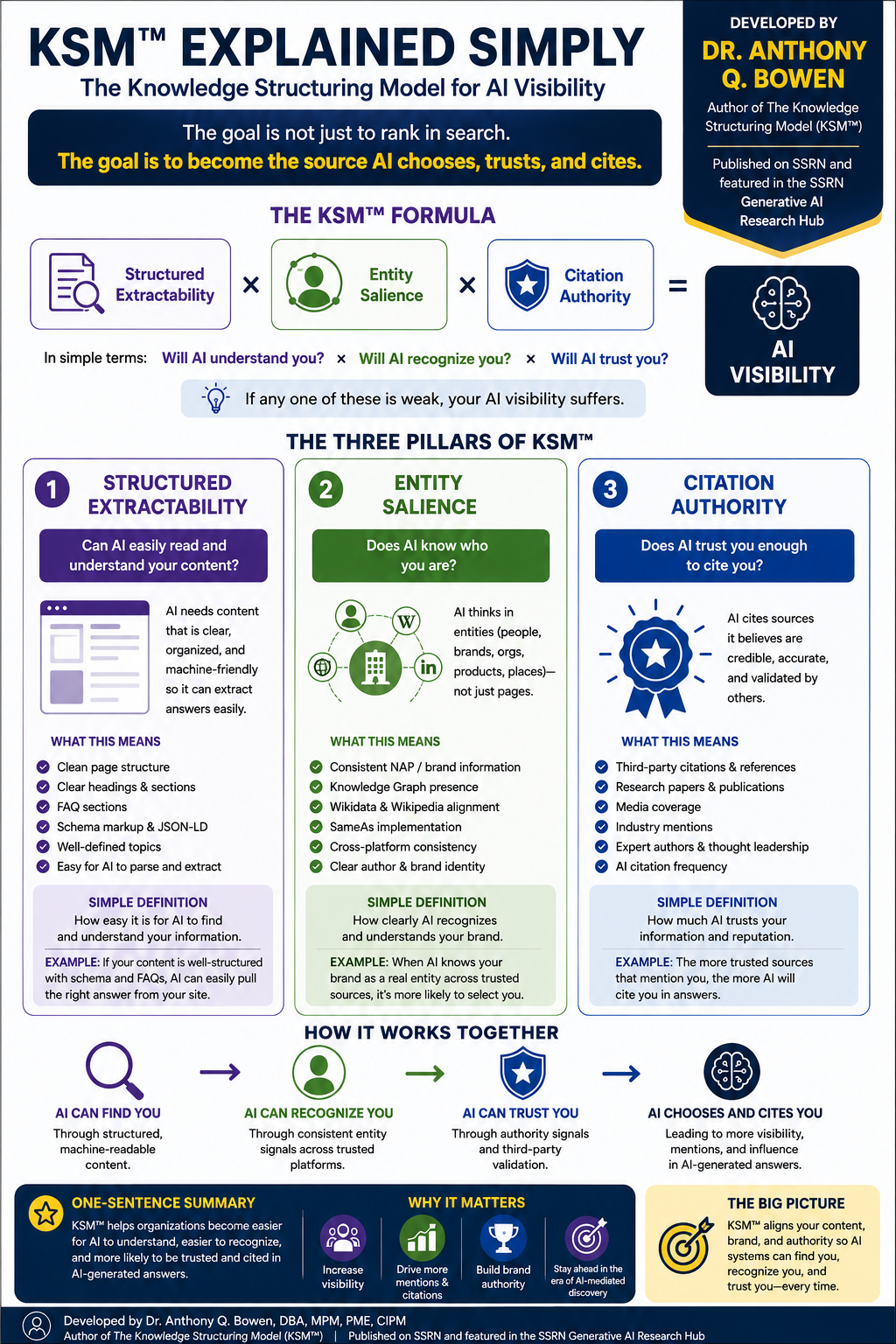
KSM™ Explained Simply
Share this with stakeholders who need the model in one screen: can AI understand you, can AI recognize you, and can AI trust and cite you?
Education
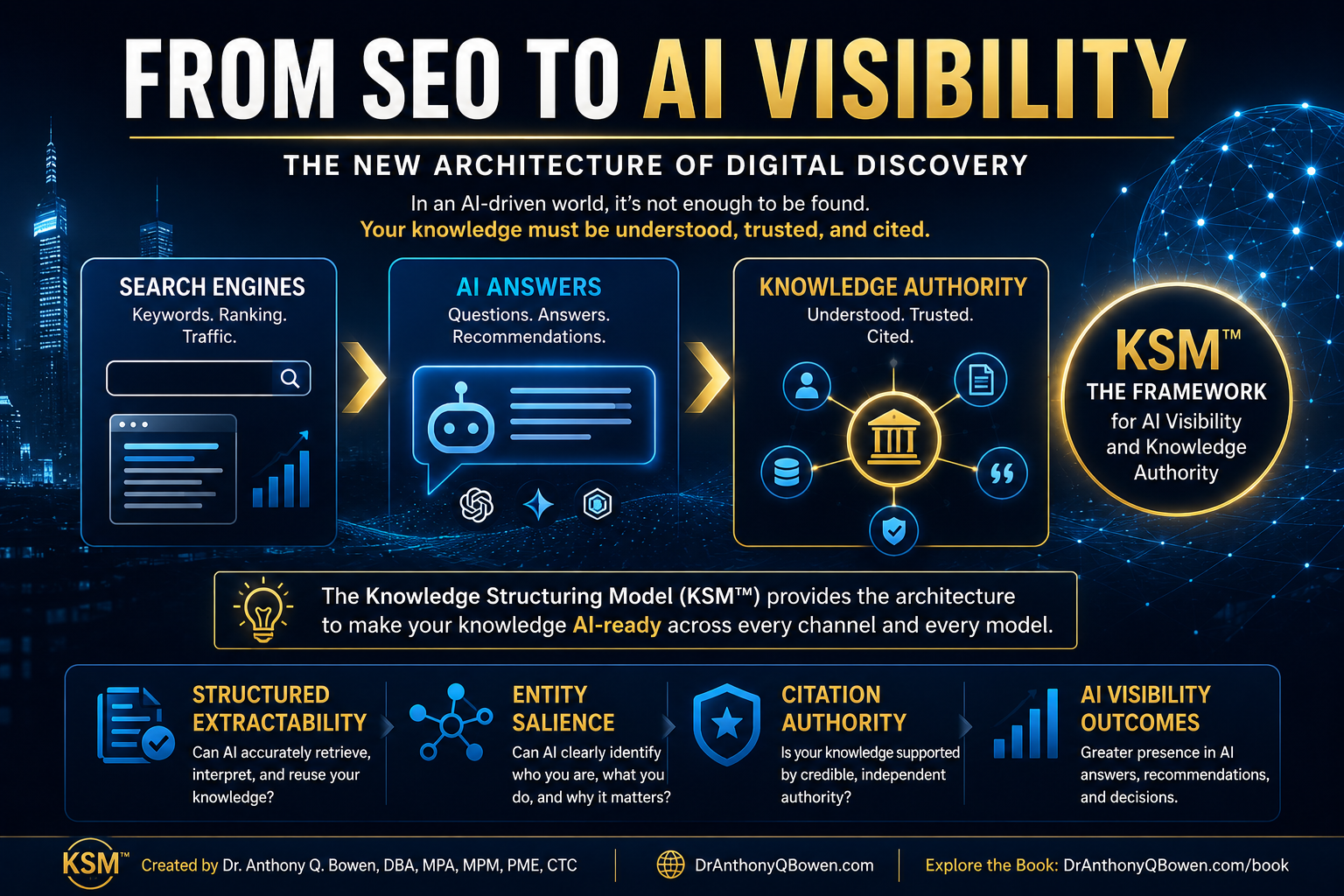
From SEO to AI visibility.
Traditional SEO remains useful for discovery and crawlability. AI visibility asks a different question: whether AI systems can understand your knowledge, resolve your entity, and find enough independent evidence to cite you.
FAQ