Tirzepatide
Initial finding
Indexing allowed: No
After remediation
URL can be indexed by Bing
No SEO/GEO issues found
New: Take the KSM™ AI Visibility Assessment and identify what is limiting your visibility in AI-generated answers. Start now
KSM™ Client Case Study
From a 35/100 pre-launch KSM™ baseline, to 62/100 on Day 1, to 85/100 at Day 30.
PeptideDoc demonstrates how the Knowledge Structuring Model™ can be applied to a physician-led healthcare organization to improve how search engines and AI systems understand the organization, recognize physician authority, connect services and location, and find independent evidence that reinforces trust.
Pre-Launch
35/100
Day 1
62/100
Day 30
85/100
Improvement
+50 Points
01 · Starting point
PeptideDoc began with something many healthcare organizations already have: real physician expertise, an established medical practice, clinical services, and a physical location.
What it did not yet have was a consistently structured digital knowledge layer.
Search engines and AI systems had to interpret information distributed across webpages, physician profiles, service descriptions, business listings, directories, and external references.
The challenge was therefore not simply traditional SEO. The challenge was whether machines could clearly determine:
“What is PeptideDoc? Who owns and leads it? Where is care provided? What services does it offer? Which physician is responsible for care? And which external sources confirm that information?”
02 · Baseline
Structured Extractability
16/40
Entity Salience
14/40
Citation Authority
5/20
Total
35/100
The practice existed. The physician existed. The services existed. But the digital relationships between them were fragmented.
03 · Day 1 implementation
The first implementation phase focused heavily on Structured Extractability and Entity Salience.
04 · Day 1 result
Structured Extractability
30/40
Entity Salience
24/40
Citation Authority
8/20
Total
62/100
Improvement
+27 Points
The first phase demonstrated that PeptideDoc had become substantially easier for machines to interpret. The website was more structured. The physician relationship was clearer. The physical location and service relationships were more explicit.
But Day 1 also exposed the next constraint.
Day 1 evidence · External validation
Bing Webmaster Tools was used as an external technical validation source for priority service pages.
Initial finding
Indexing allowed: No
After remediation
URL can be indexed by Bing
No SEO/GEO issues found
Bing result
URL can be indexed by Bing
No SEO/GEO issues found
Bing result
URL can be indexed by Bing
No SEO/GEO issues found
Tirzepatide was also aligned with the stronger structured-data architecture used by the other priority service pages.
10 strategic pages were standardized for:
Consistent entity IDs
https://peptidedoc.com/#clinic
https://peptidedoc.com/#dr-maslavi
Persistent IDs help machines understand that references across multiple pages describe the same clinic and the same physician.
On Day 1, PeptideDoc was explicitly configured in Google Search Console to allow its links and content to appear in Google's Search generative AI features, including AI Overviews and AI Mode.
This setting does not guarantee an AI citation. It ensures that PeptideDoc is not excluded from participation while KSM™ works to improve the structured, entity and authority signals that influence visibility.
05 · Day 1–30
The Day 1–30 phase expanded the entity beyond the website.
“If PeptideDoc says something about itself, can independent sources say the same thing?”
That is the shift from owned information to corroborated information.
06 · Day 30 result
| Pillar | Pre-Launch | Day 1 | Day 30 |
|---|---|---|---|
| SEStructured Extractability | 16/40 | 30/40 | 36/40 |
| ESEntity Salience | 14/40 | 24/40 | 34/40 |
| CACitation Authority | 5/20 | 8/20 | 15/20 |
| Total | 35/100 | 62/100 | 85/100 |
+23 points from Day 1
+50 points from Pre-Launch
Healthcare study · Measured results
Three measured checkpoints in PeptideDoc’s application of the Knowledge Structuring Model™. Day 60 and Day 90 remain future measurements.
On a 0–100 scale: Pre-Launch 35/100 → Day 1 62/100 (+27 points) → Day 30 85/100 (+50 total points).
Grouped bars compare Pre-Launch, Day 1 and Day 30. Structured Extractability (SE) and Entity Salience (ES) each have a maximum of 40; Citation Authority (CA) has a maximum of 20. All values appear in the table below.
| Pillar | Pre-Launch | Day 1 | Day 30 |
|---|---|---|---|
| Structured Extractability (/40) | 16/40 | 30/40 | 36/40 |
| Entity Salience (/40) | 14/40 | 24/40 | 34/40 |
| Citation Authority (/20) | 5/20 | 8/20 | 15/20 |
| Total KSM™ score | 35/100 | 62/100 | 85/100 |
Pre-Launch to Day 1 brought a 27-point increase, from 35/100 to 62/100. Structured Extractability rose from 16/40 to 30/40 and Entity Salience from 14/40 to 24/40 as pages, structured data and physician-practice-location relationships became clearer. Citation Authority rose from 5/20 to 8/20 but remained the next constraint.
Day 1 to Day 30 added another 23 points, reaching 85/100 — 50 points above baseline. Structured Extractability reached 36/40, Entity Salience 34/40 and Citation Authority 15/20 as the entity expanded across external profiles, professional references, patient education and independent sources.
The constraint shifted from digital structure toward topical authority and independent corroboration. The next opportunity is not simply more pages: it is stronger answers to real patient questions and independent evidence reinforcing the same physician-practice relationships.
These KSM™ scores describe the measured knowledge, entity and authority signals. They do not measure actual AI recommendations or patient acquisition, and do not establish those outcomes. Day 60 and Day 90 results have not yet been measured.
07 · What changed
Pre-Launch
Can AI understand the organization?
Day 1
Can AI recognize the organization and connect the right entities?
Day 30
Can AI find enough independent evidence to trust and corroborate those entities?
Structured Extractability → Entity Salience → Citation Authority
Understand → Recognize → Trust
09 · Patient education
The Day 1–30 phase also introduced a stronger patient-education layer. Rather than building content around generic peptide keywords alone, PeptideDoc began addressing the questions patients may ask before choosing a provider.
10 · Day 30 finding
At the start of the case study, the primary constraint was digital structure. By Day 1, the owned knowledge layer had improved substantially. By Day 30, entity recognition and external corroboration had become much stronger.
The next bottleneck is: Topical Authority + Independent Citation Authority
The organization no longer simply needs more pages. It needs stronger answers to real patient questions and more independent sources that reinforce the same physician-practice relationships.
11 · Day 31–60
The Day 31–60 phase will focus on expanding topical authority while continuing to strengthen independent corroboration.
First Day 31–60 Content Topic
Planned next content topic. The article has not been created as part of this update.
12 · 90-day progression
35/100
Fragmented structure and limited external authority.
62/100
The owned digital knowledge layer became substantially more machine-readable.
85/100
Entity relationships strengthened across external platforms and Citation Authority grew significantly.
Next Measurement
Focus: topical authority, corroboration, and AI recognition.
Final Measurement
Focus: whether the combined implementation produces sustained improvements across the three KSM™ pillars.
The infographic below summarizes the measured checkpoints above alongside the pillar-level detail behind them.
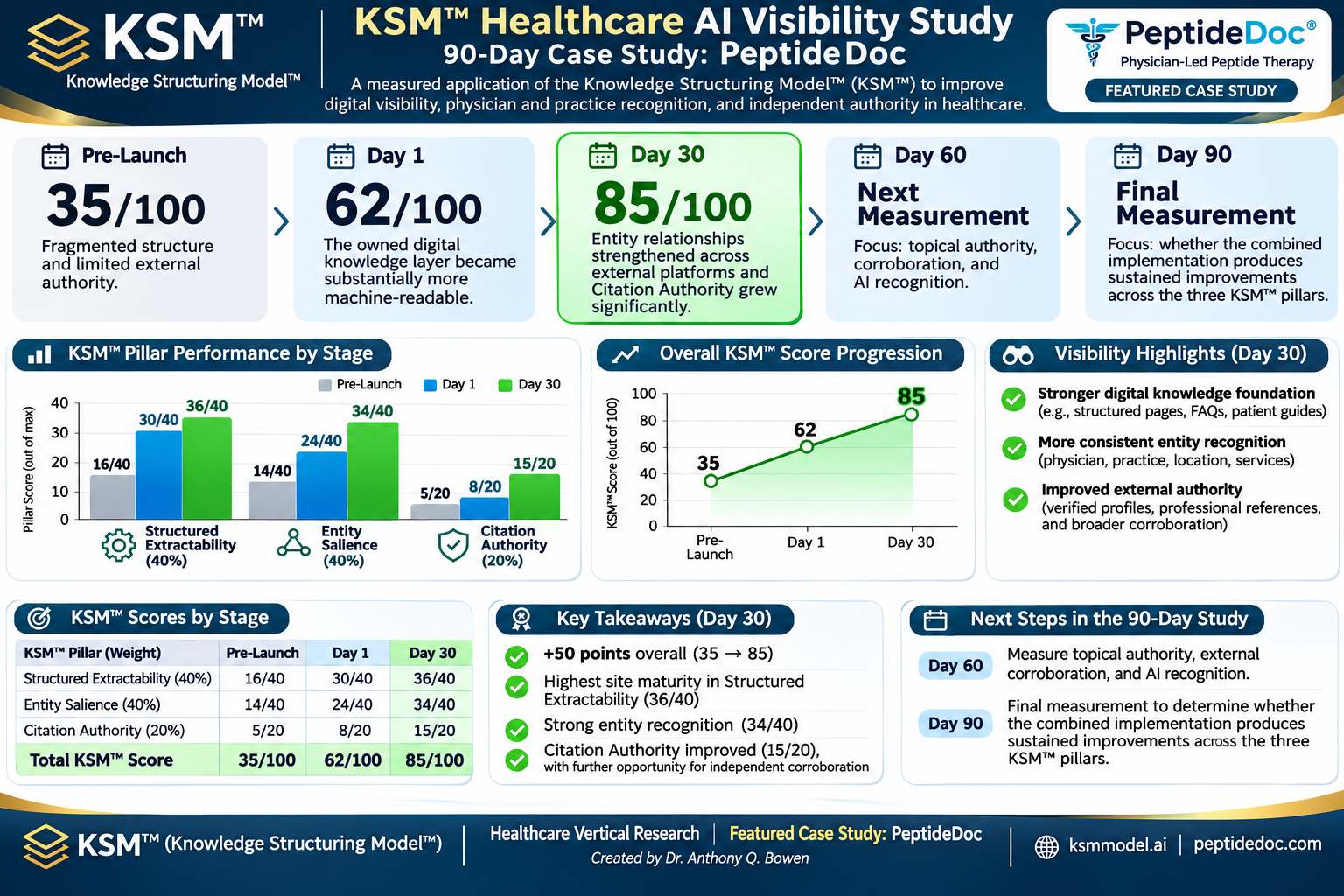
PeptideDoc's overall KSM™ score rose from 35/100 at Pre-Launch to 62/100 on Day 1, a gain of 27 points, and to 85/100 at Day 30 — a further 23 points, and 50 points above the Pre-Launch baseline. Day 60 is the next measurement and Day 90 the final measurement; neither has been scored yet.
| KSM™ pillar (weight) | Pre-Launch | Day 1 | Day 30 |
|---|---|---|---|
| SEStructured Extractability (40%) | 16/40 | 30/40 | 36/40 |
| ESEntity Salience (40%) | 14/40 | 24/40 | 34/40 |
| CACitation Authority (20%) | 5/20 | 8/20 | 15/20 |
| Total KSM™ score | 35/100 | 62/100 | 85/100 |
Next steps shown in the graphic: Day 60 will measure topical authority, corroboration and AI recognition. Day 90 is the final measurement of whether the combined implementation produces sustained improvements across the three KSM™ pillars.
Research Question
Once AI can understand and correctly recognize a healthcare organization, does independent external corroboration become the primary constraint on whether that organization is trusted, surfaced, and cited?
PeptideDoc provides a real-world healthcare environment for testing that question over time.
Next step
PeptideDoc is the first paid client deployment in the KSM™ Multi-Vertical SMB AI Visibility Study.